Samarkand: Home of the Timurids
Samarkand, Uzbekistan - June 2026
I reached Samarkand at dusk after a shared taxi to the Tajik border and border crossing on foot. Arriving in the Samarkand town center, I walked straight to Registan Square. Having been there two years earlier, I skipped the tour guides and just walked around it.
The Registan is three madrasas (Islamic schools) facing one another across a public square, and the imposing scale of the site alone is breathtaking even the second time. The oldest is Ulugh Beg’s, finished in 1420 by the great conqueror Amir Timur’s grandson. Timur, known in the West as Tamerlane, was the 1300s conqueror who made Samarkand the capital of an empire reaching from Central Asia into Iran, India and Anatolia, and who spent much of the wealth he took rebuilding the city. Since Uzbekistan’s independence, the state has also co-opted Timur as its national hero, a key part of the government’s effort to build an Uzbek national identity.
The Registan, Samarkand
Three madrasas around one square. Drag to look around, then tap a numbered point to learn what you are seeing.
Another of the Registan’s madrasas, Sher-Dor, was added two centuries after Ulugh Beg’s, between 1619 and 1636, and Tilya-Kori followed between 1646 and 1660. Each has its own courtyard, rooms and style. Sher-Dor’s arches carry tigers chasing deer beneath human-faced suns, representative of the pursuit of knowledge (appropriate for a school). The square between the three buildings was leveled and paved in 1875, and tradition holds that it once served as a place of public execution. Several buildings in the complex have been restored in the century since (including by the Soviets), so the tilework in front of you is only partly original.
Before long, I found a man guarding the door to the minaret of Ulugh Beg’s madrasa. For a few dollars, he unlocked it, and I climbed a steep, winding staircase for about five minutes before stepping out at the top. The stunning view ran a full 360 degrees, with the sun setting over Samarkand’s new town and the square laid out below. I had the minaret entirely to myself and a quiet view of the Registan from above the city and crowds.
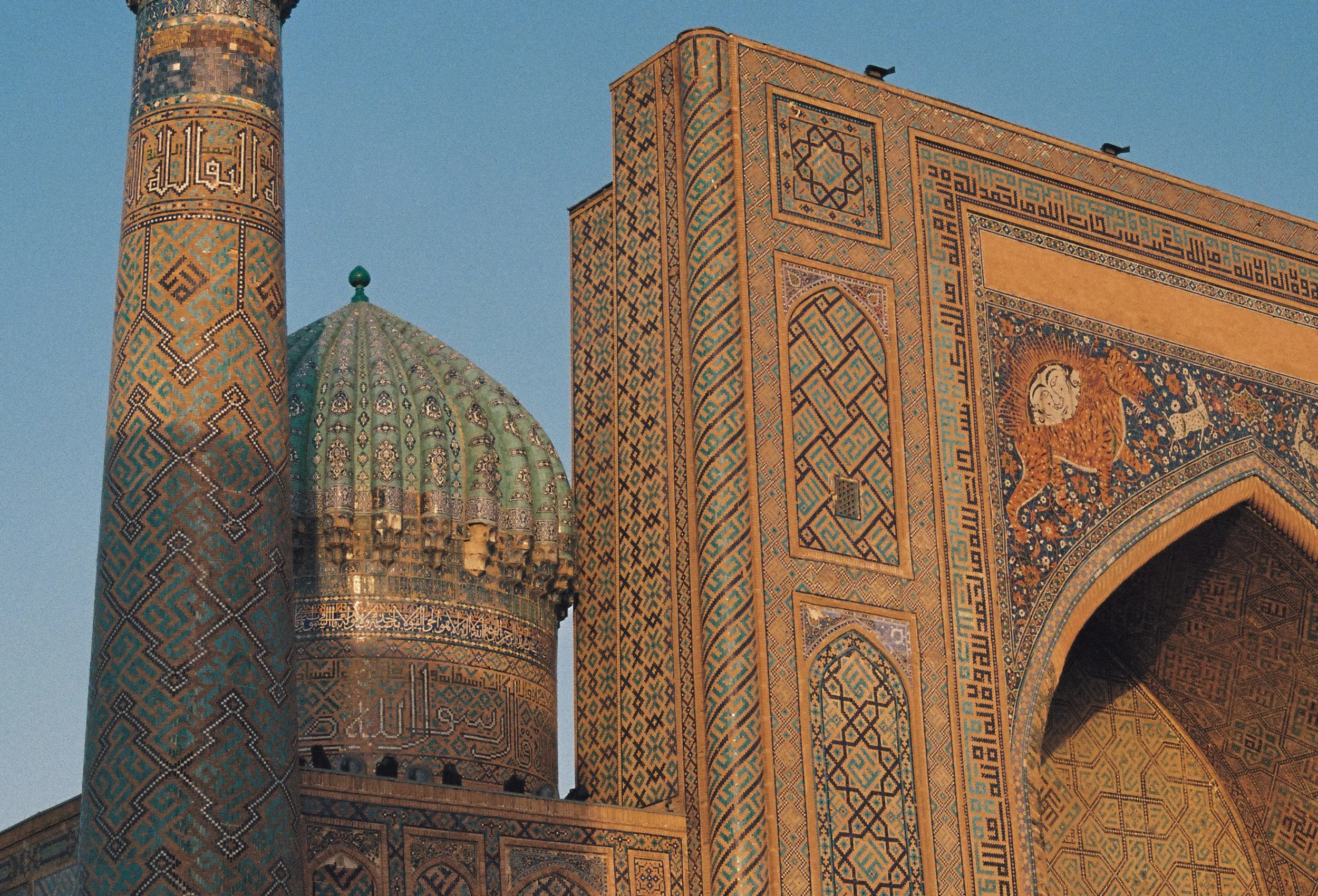
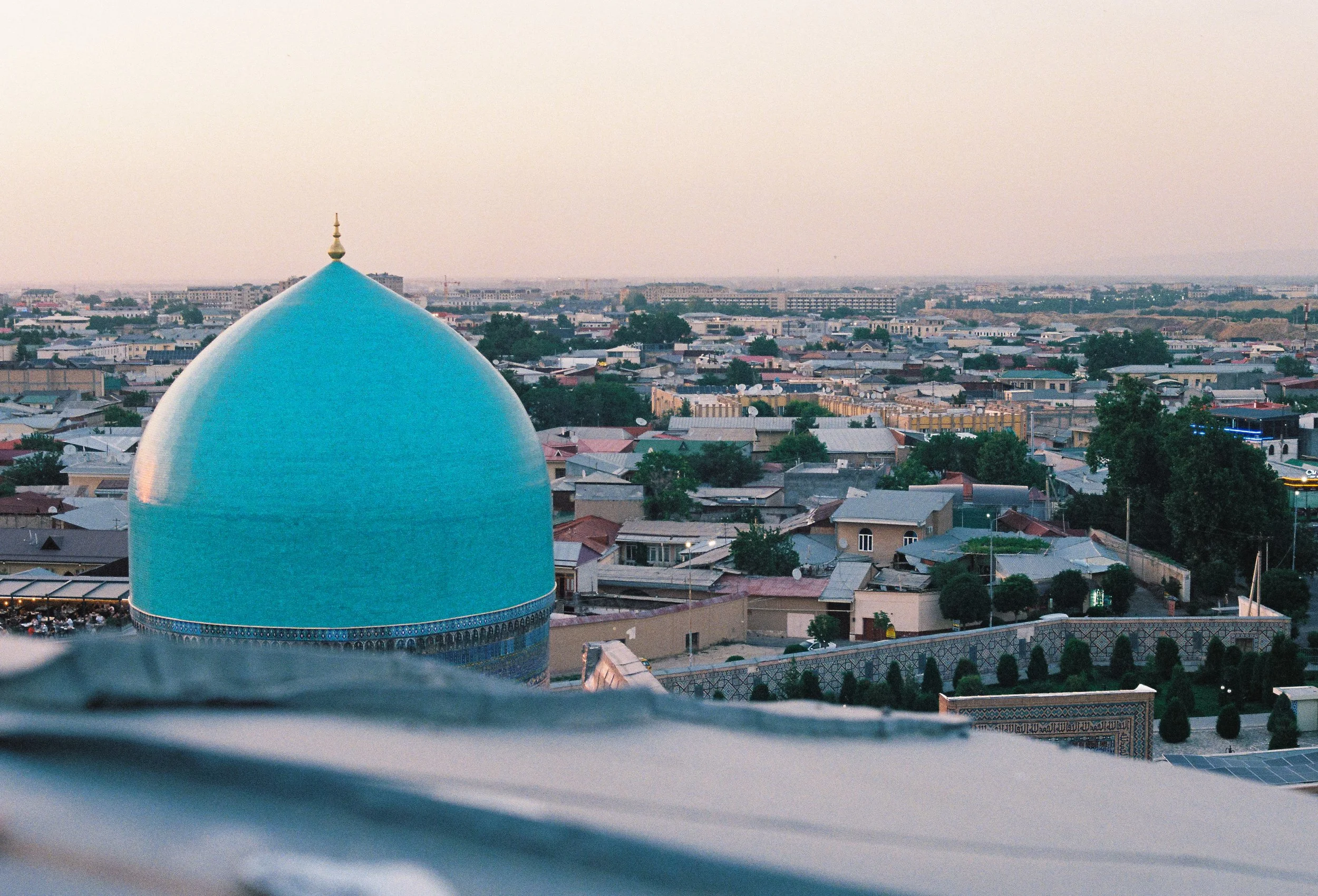
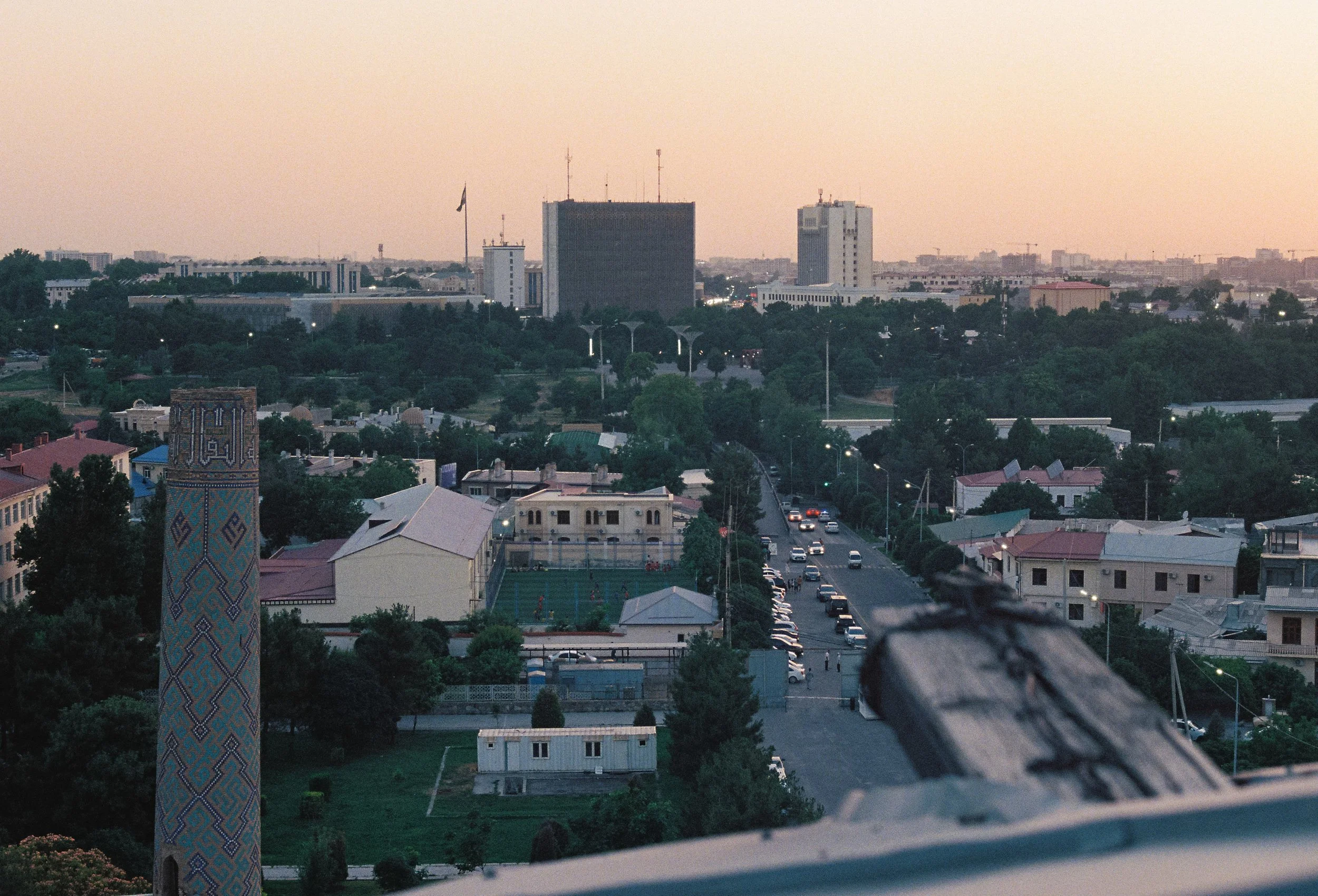
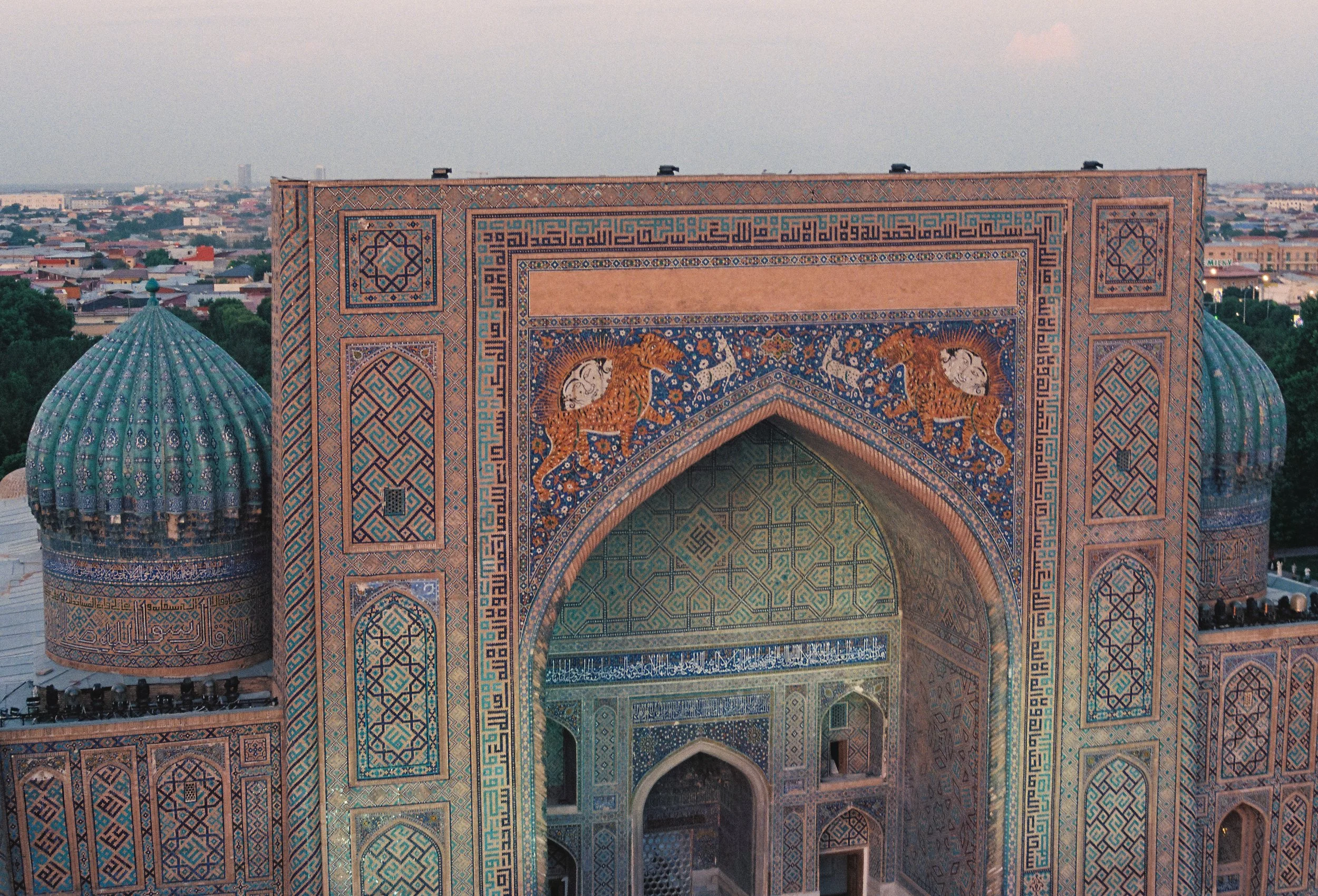
Photos: Views of the Registan complex, including taken from the top of the Ulugh Beg minaret
That night, I rested in a boutique hotel beside the Bibi-Khanym Mosque, and from my window, I could see its tiled dome and mosaics. Timur ordered the mosque after his 1399 campaign in India and it was finished around 1404, with a intricate blue dome roughly 40 meters tall and walls enclosing a large courtyard (it was designed to hold the city’s entire male population for Friday prayers).
The next day, I also walked through the Gur-e-Amir, the tomb of Amir Temur. It was begun in 1403 as a mausoleum for Timur’s grandson Muhammad Sultan, and when Timur died in the winter of 1405, he was buried there. Ulugh Beg, his grandson, lies in the same crypt. Timur’s gravestone was once a single block of dark green jade, which Nadir Shah took to Persia in 1740 and which broke into two pieces on the way. The most surprising part of the tomb’s history came in 1941, when the Soviet anthropologist Mikhail Gerasimov opened the crypts. He confirmed once and for all that Timur had been lame in his right leg and arm, and that Ulugh Beg had been beheaded.
That Soviet layer in Samarkand easy to find in the city once you start looking and much more visible than in Bukhara. Samarkand was the capital of the Uzbek SSR from 1925 until 1930, when Tashkent replaced it. During those decades, the Soviets demolished churches and the Shaybani Khan madrasa, yet they also put real money into restoring the Timurid monuments, including Bibi-Khanym and the Gur-e-Amir. A short walk from the tomb, I found a Soviet-style mural on the side of an apartment block, a historical shard that isn’t in any of the guidebooks.
In the morning, I had breakfast in the old town before heading to the train station. I reflected on the layers of history in Samarkand and its incredibly grand monuments. The Registan is as impressive as some world wonders I had seen and gets far less attention. Yet, even in the two years between my trips to the city, I could see tourism and development growing. The night before my arrival in 2026, John Legend had performed in the Registan, a sign of the West’s growing appreciation for Uzbekistan and Uzbekistan’s push to open its borders. If Bukhara is the past and Tashkent the shiny modern future, Samarkand is the city where those worlds meet, old and new side by side.
If you go…
The Afrosiyob high-speed trains connect Samarkand to other major cities
Summer usually reaches 100°F, so plan early mornings and evenings as prime time and rest in the middle of the day
There is a cute boutique hotel next to Bibi-Khanym mosque, so close that the dome is visible from the balconies
Find someone in a shop or near the Ulugh Beg minaret and see if you can convince them to let you up for an exclusive and spectacular view
When you have windows to rest, enjoy a slow paced meal in a traditional teahouse (Chayhana)
Choose SamarKind cafe for clean and plant based food options
