Issyk Kul: Rural Kyrgyzstan’s Past and Present
Issyk Kul, Kyrgyzstan - August 2024
The road from Bishkek to Lake Issyk Kul took us from the heart of the city into rural farmland without hesitation. I had found a cab driver who was willing to take me all the way to the lake along the Southern shore. However, our first stop was a roadside restaurant for tea and a local flatbread bread called kattama. No more than an outpost on the side of the road, the restaurant served up some of the most delicious bread I’d had to date and the tea was a welcomed refreshment. We paused a few more times on the way to grab fresh apples and for me to marvel at a couple of old bus stops. Soviet planners classified bus stops as “minor architectural forms,” a category small and cheap enough to escape most construction standards, so architects used them as testing grounds. Along the lake road, the results were tile mosaics, concrete curves and a few shapes that seemed to borrow from the yurt or the felt kalpak hat, Soviet socialist forms combined with local influence.
Issyk Kul sits at 1,607 meters elevation, reaches 668 meters at its deepest, and covers more than twelve times the surface area of Lake Tahoe. Its Kyrgyz name, Ysyk-Köl, means “Hot Lake,” which sounds wrong at that elevation until you learn that it rarely freezes despite long, harsh winters. The Chinese monk Xuanzang passed along its shore in the seventh century and described it in his account of the Western Regions, and caravans on the Silk Road used it as a stopover. In the twentieth century, the Soviet Union turned its Northern shore into a holiday coast of sanatoria and boarding houses. I spent my first night in a yurt camp on the middle of the Southern shore, where I could experience first hand the felt dwellings that many Kyrgyz still call home today. The next morning, I ate and swam in the lake at dawn before heading East again.
Karakol, a larger town at the at the far East end, began in 1869 as a Russian military outpost and spent most of the next century being renamed. The Tsar made it Przhevalsk in 1889 after the explorer Nikolay Przhevalsky, local protests restored the name Karakol in 1921, Stalin reversed that in 1939, and the town stayed Przhevalsk until 1991. The population still reflects the frontier it once was. Dungans, Chinese-speaking Muslims who fled warfare in China in the 1880s, settled here and built a mosque, and Russians and Uyghurs remain among the town’s largest minorities.
The Route
Select a stop to see what happened there
Stop positions are approximate. The route follows the main roads, simplified, and distances are by road. Roads and the lake outline © OpenStreetMap contributors.
One of the town’s most beautiful buildings is the colorful and wooden Holy Trinity Cathedral. The church was built in 1895 on a brick base and designed by engineers from Almaty, but after the 1917 revolution and the abandonment of religion, it became a school, a sports hall, a theater and a coal store. By 1982 it was abandoned, and after restorations, the Orthodox community got it back in 1991. I joined the worshippers inside in offering candles to various saints. The people inside themselves were relics of the past (and overhwhelmingly Russian). I saw one Russian grandpa in a Soviet Union boxing tracksuit and dreamt of his bygone career as the world champion of a country that no longer exists.
The Soviets left their mark in Karakol too, and as I strolled the town center, I was delighted to stumble on a Lenin statue on one of the central squares. Atop a stone plinth with his hand oustretched, the communist revolutionary seemed to be gesturing toward something his statue had outlived. Kyrgyzstan has not been as eager as Uzbekistan or the Baltics to take down its Lenin statues, reflecting a complicated relationship with its own past. However, Bishkek moved its Lenin in 2003 to a smaller square behind the State History Museum, and Osh took down the tallest in Central Asia in June 2025, a year after my visit. These moves are steps not to erase Soviet history necessarily, but to build a new national narrative.
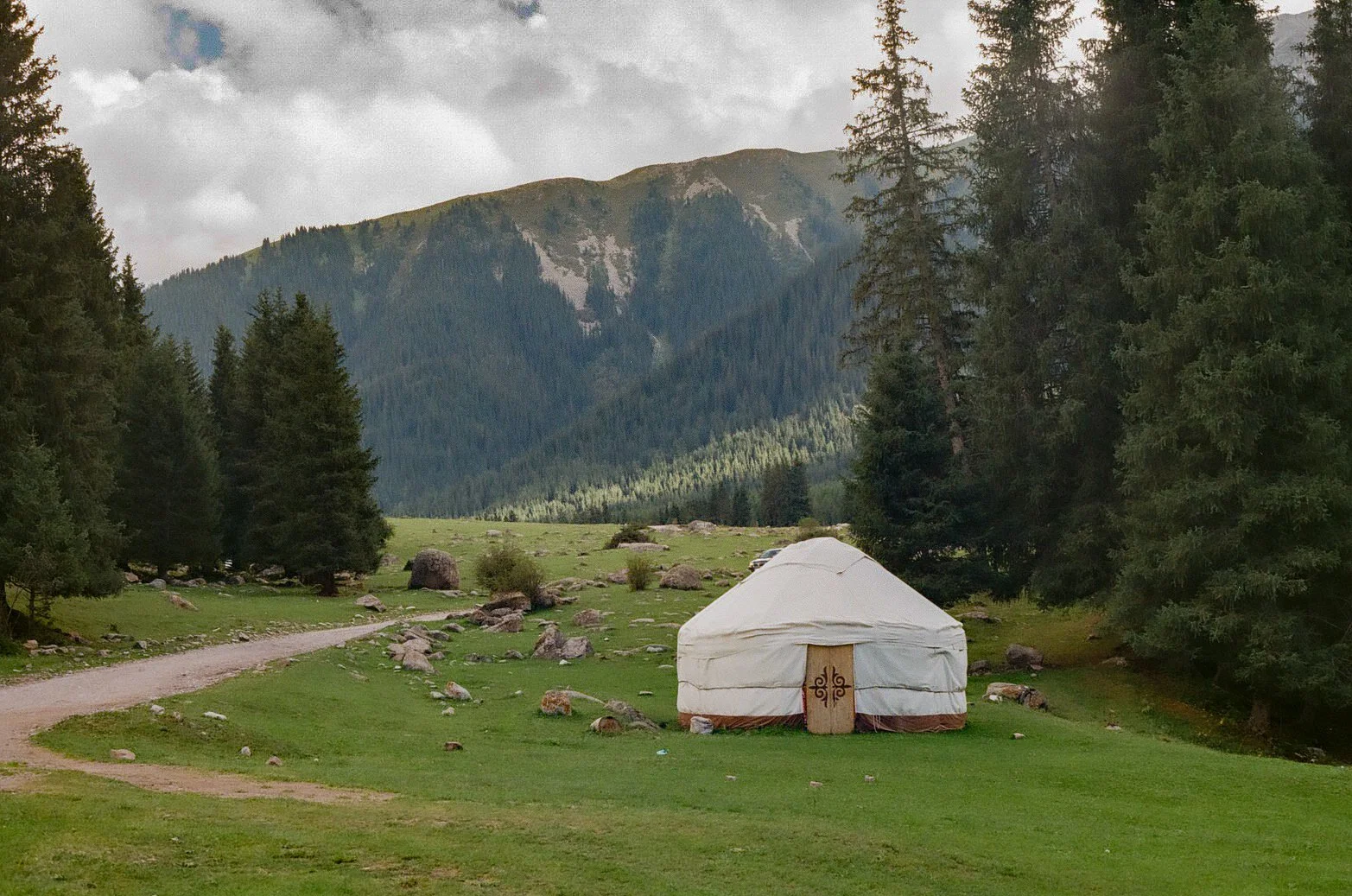
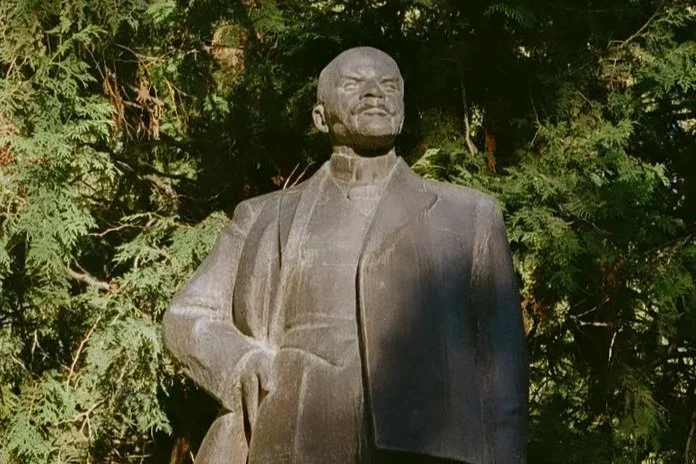
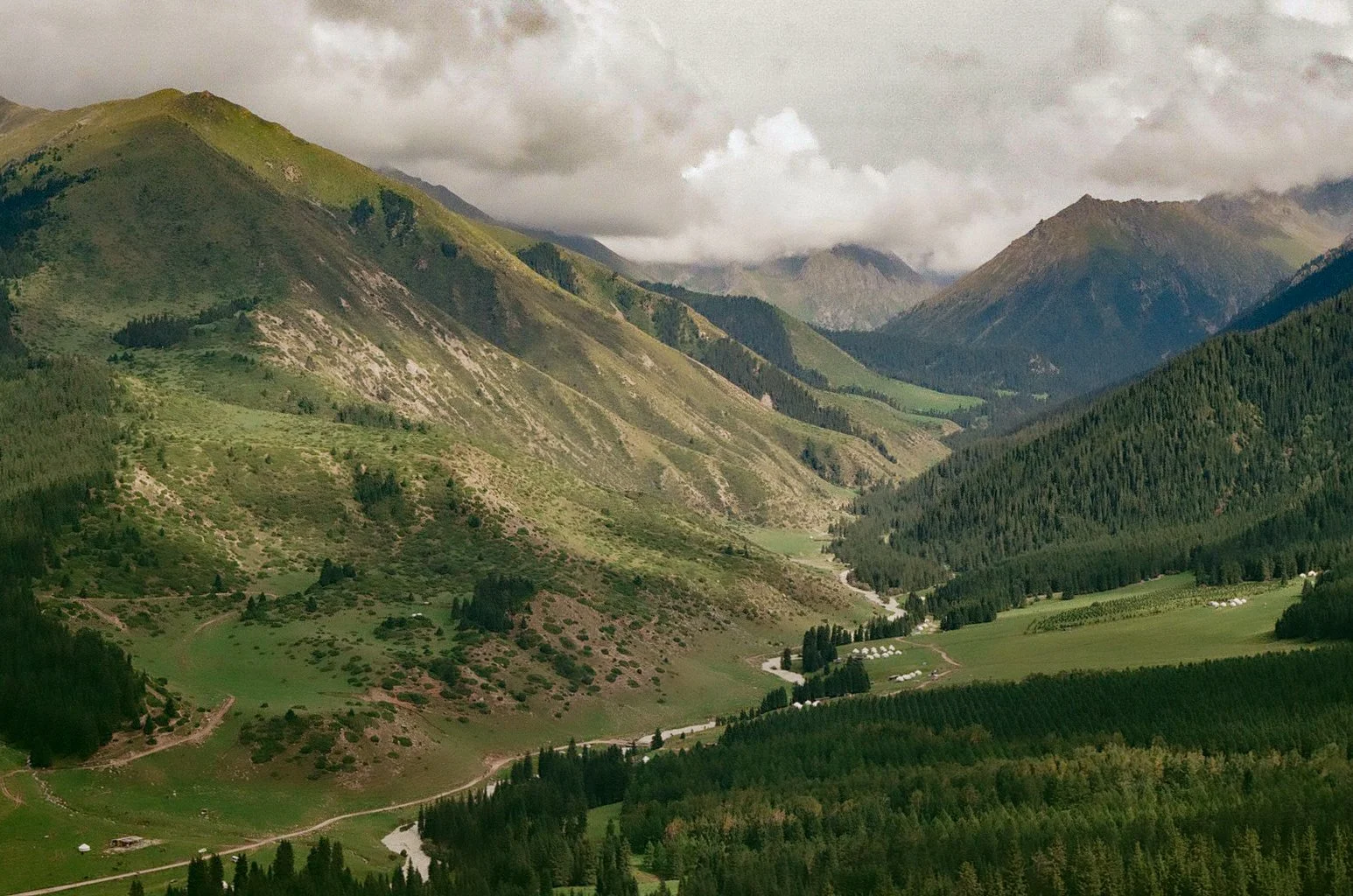
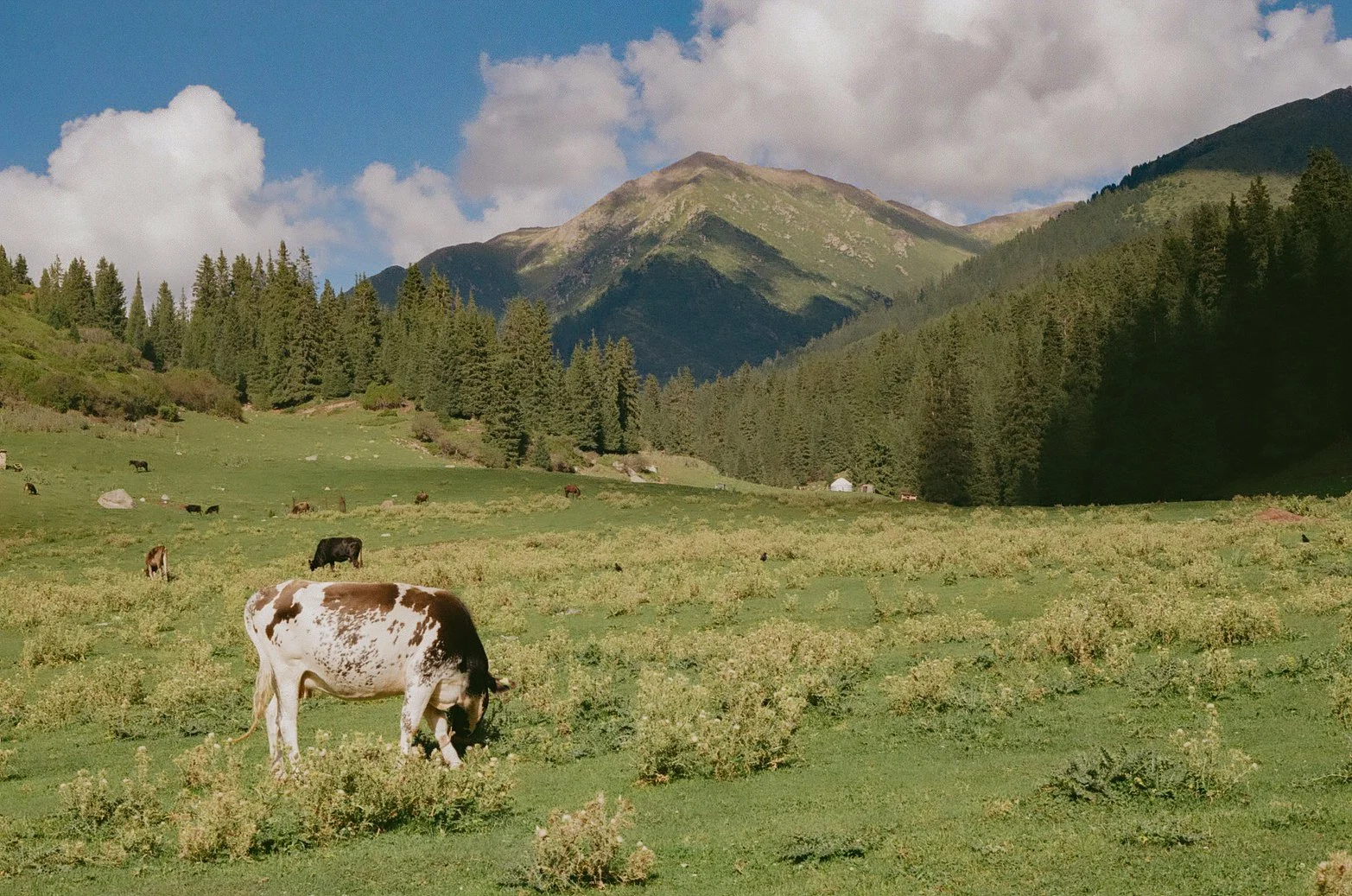
Photos: Scenes from Jeti Oguz, from Lenin to cows and yurts
The next morning, the weather cleared and the mountains were visible on every side of the lake. I took a road South into the valley of Jeti Oguz, named for a line of red conglomerate cliffs that looks like seven bulls in a row. Jeti Oguz is reprentative of a typical scene in rural Kyrgyzstan. Fresh spring water rushing down from the high peaks through bright green valleys, and horses and white yurts dotting the undulating green hills. It was a supremely peaceful and natural atmosphere and I decided to hike into the lower peaks to look around. I stopped for tea and a snack in a yurt camp and was welcomed by the locals.
On the way down, I encountered a local family enjoying the day with a massive picnic. They were friendly and beckoned me over as I passed by. I joined them and enjoyed tea, honey, fruit, bread, and more, and loved getting a taste of the local customs. The people could not have been friendlier or more generous with what they had.
The Picnic


Before going back to Karakol, I wandered through the ruins of a Soviet sanatorium near the foot of the rocks. Under the Soviet system, a stay in a place like this was typically a benefit handed out through workplaces and trade unions, a state-supplied vacation for people who had earned it. Now it looked as if it had been abandoned the day the Berlin Wall fell, with a Lenin statue in the garden alongside other Soviet symbols. I do not know whether anyone in the family on the hillside had ever stayed there, but the habit the sanatorium was built to serve, a day set aside to sit outside and eat in good weather, was clearly still intact.
The way out was the part I remember most. The border crossing back into Kazakhstan was in the middle of nowhere, and I got lucky when someone on the Kazakh side drove me to the nearest town. There, I joined a family headed to Almaty in a car packed with with two women, a man, a baby and two children, and the whole trip went to plan. Shared taxis are a crucial part of the transportation network in Central Asia, as public transit can be scarce outside the big cities.
If you go…
Hire a driver in Bishkek for the ride to the lake and agree on stops and price in advance
Drivers can be found on Yandex and its worth asking drivers you use in Bishkek about longer trips organized off the app
Yurt camps and small hotels along the shore are the easiest option (the North side of the lake has larger hotels and resorts)
In Karakol, visit the Dungan Mosque and Holy Trinity Cathedral for two equally interesting religious sites
If visiting on market days, Karakol has a flea market, livestock market, and car market that are all interesting windows in local life and potential souvenir hunting destinations
Eat at Dastorkon for a proper Kyrgyz dinner and enjoy kattama, tea, eggs, stew, and fruits as staple snacks on shorter stops
Border crossings can be remote and drivers are typically not willing to cross borders, so plan for both sides of the borders
