Derwaza: A Little Sympathy for the Devil
Derwaza, Turkmenistan - June 2026
I reached the Shavat border crossing at nine in the morning when it opens, and joined a crowd made up mostly of traders hauling goods in both directions and a handful of tourists who looked about as certain of what they were doing as I was. Turkmenistan is still one of the most closed countries on earth, the kind of place that gets mentioned in the same breath as Eritrea and North Korea, and you cannot simply turn up with a backpack. A government approved tour agency has to write you a letter of invitation, and then you hope that their driver is waiting at the border when you cross and leave the internet and outside world behind. I waited a long time to be stamped out of Uzbekistan before crossing a buffer zone about a mile wide on a shuttle bus. On the Turkmen side, my driver met me and walked me through screening, immigration and a COVID test, and what struck me most about the whole process was how ordinary it felt.
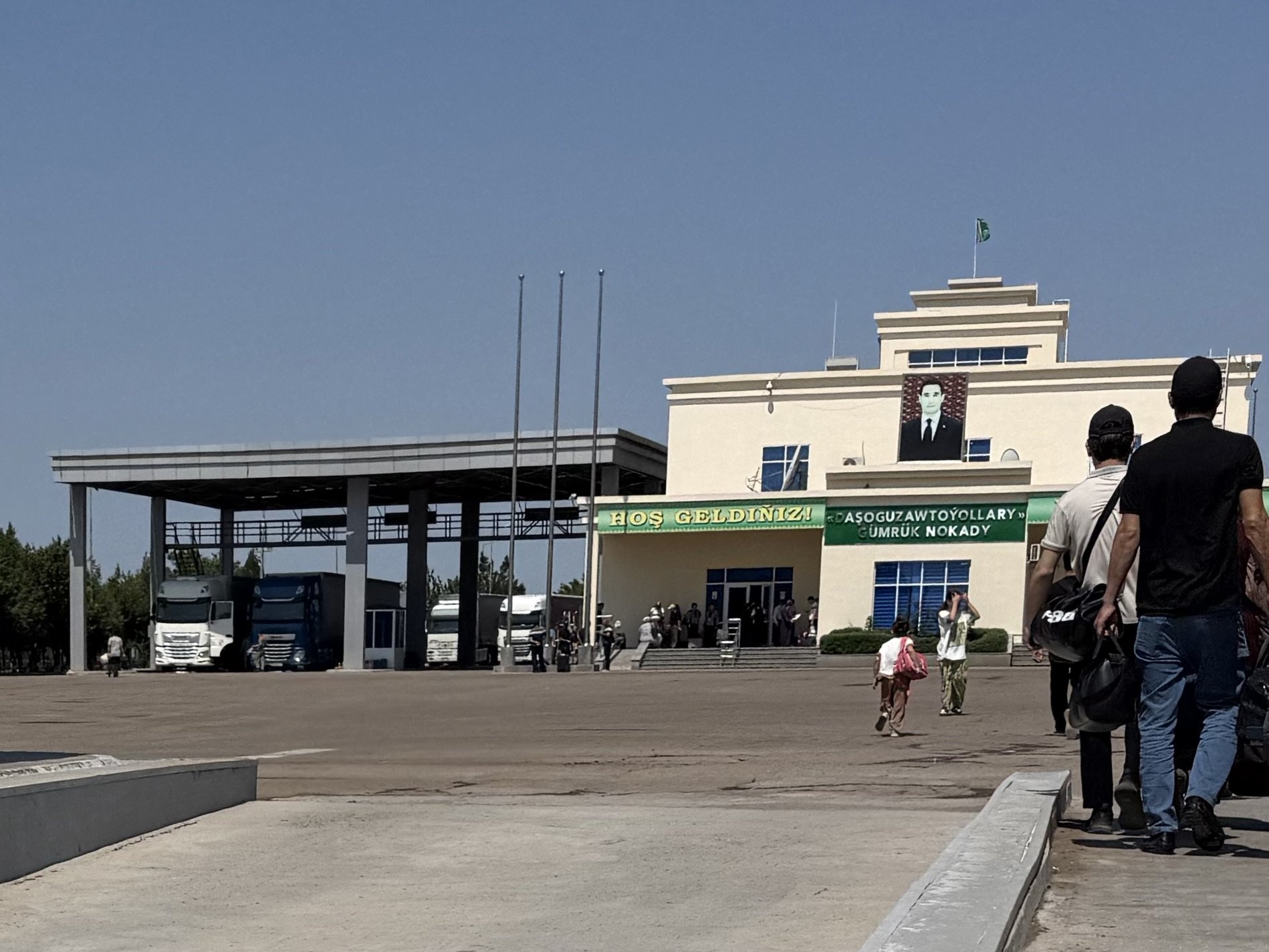
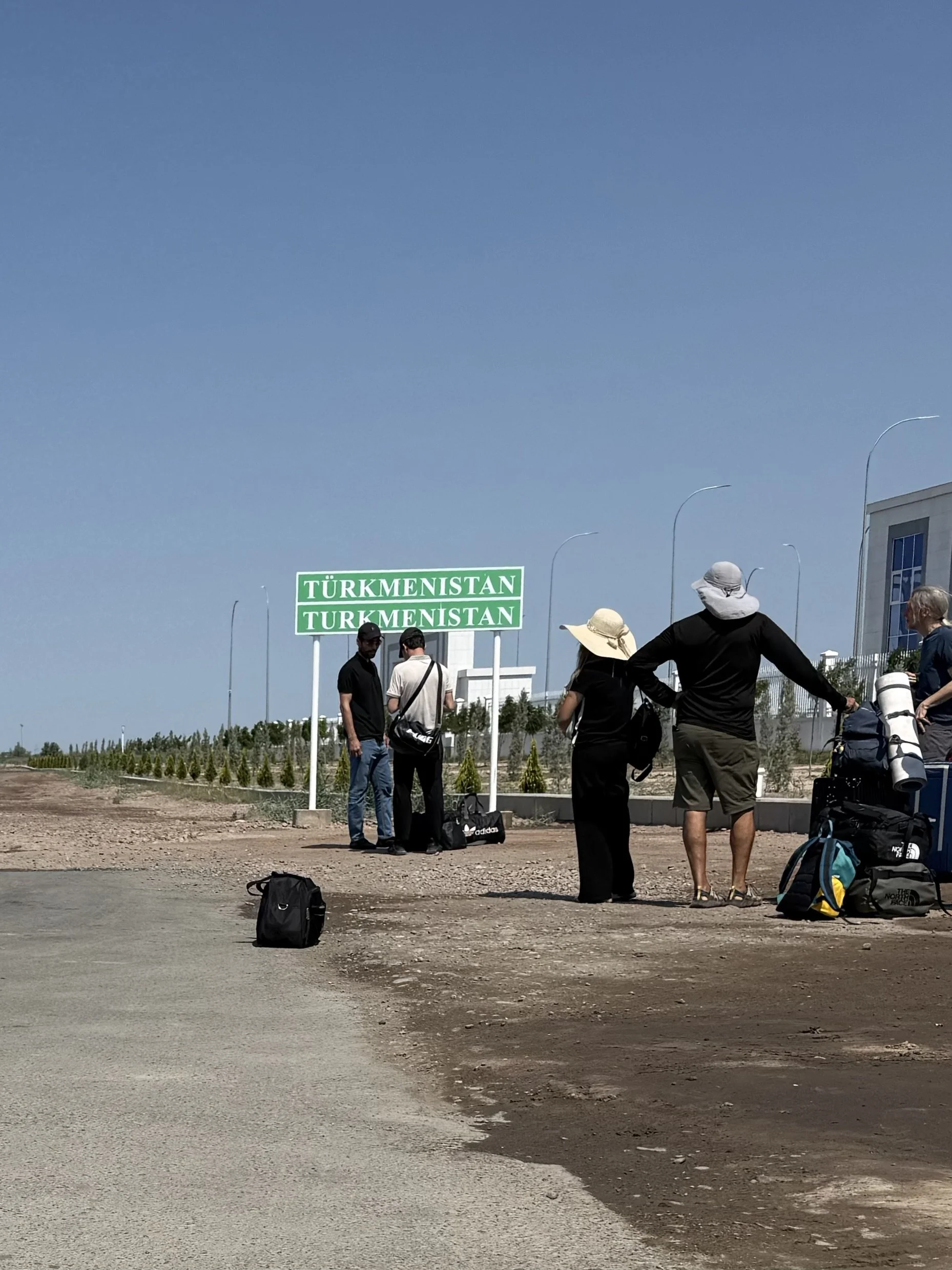
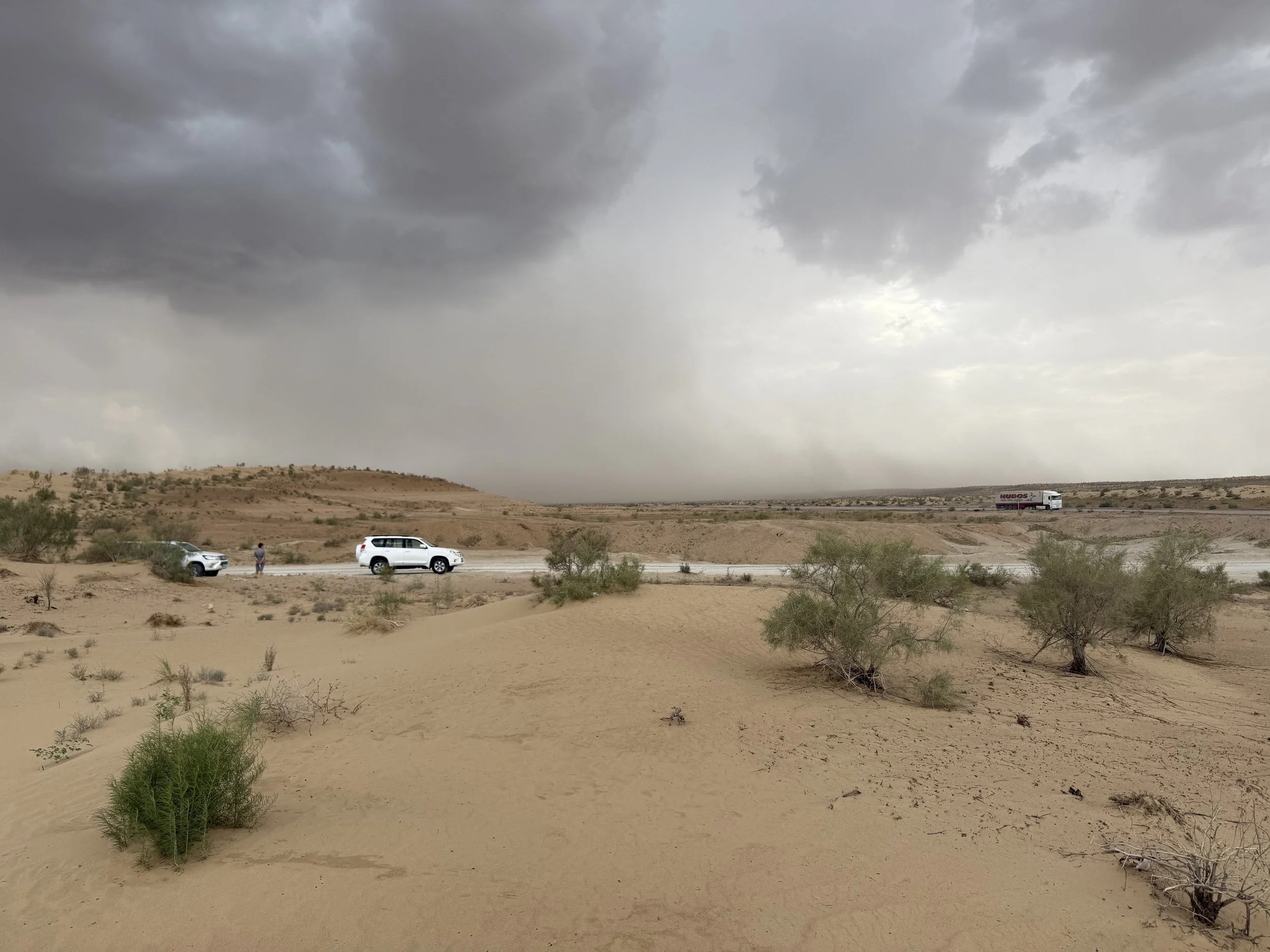
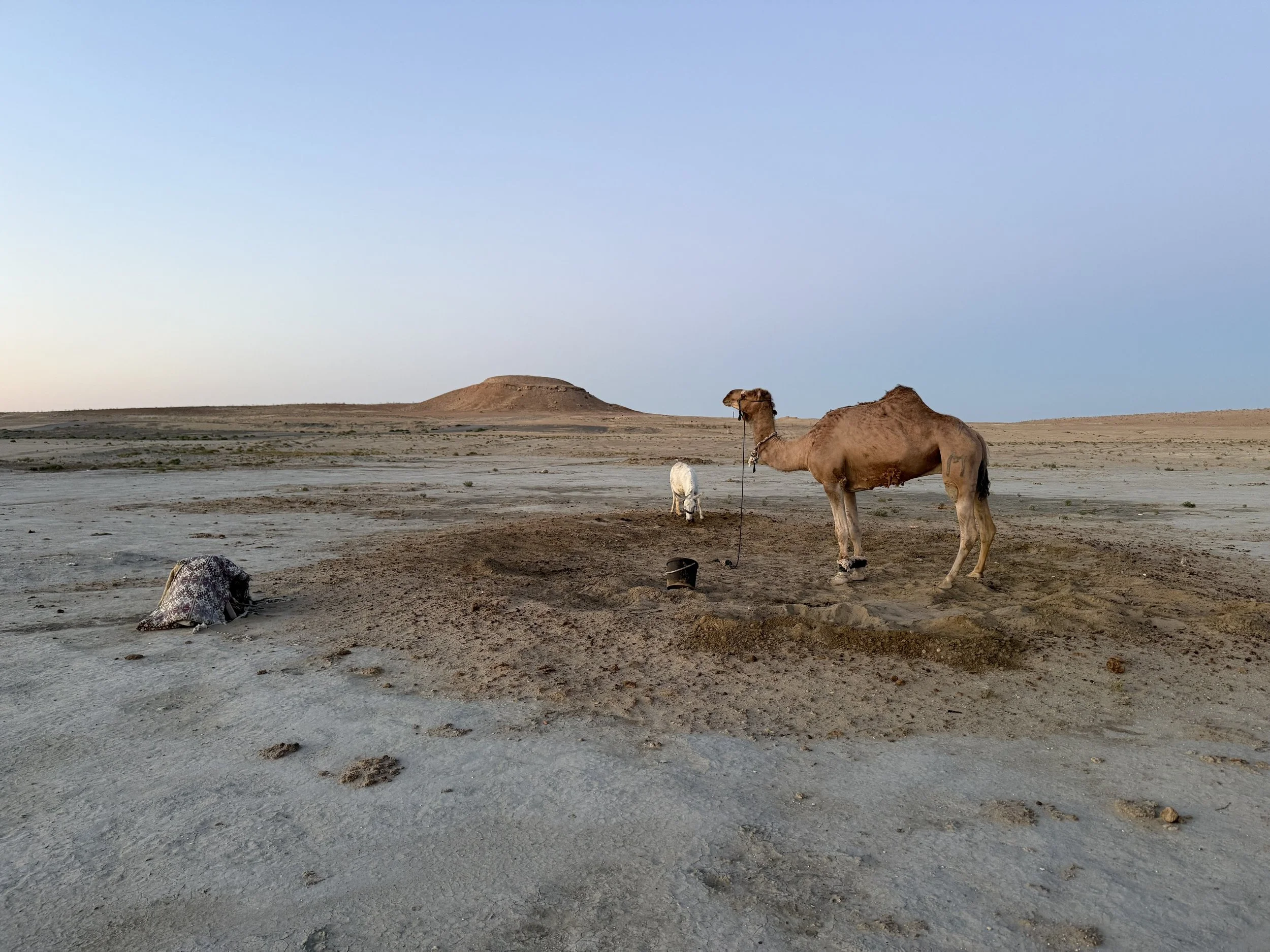
Above: The Turkmen border outpost and scenes crossing the harsh Karakum Desert
My image of Turkmenistan going in was white marble towers and avenues wide enough to land a jet on, so I was not ready for how little the drive through the border town of Dasgouz looked like that. The villages and farmland could have passed for rural Uzbekistan or Tajikistan, and the road toward the crater got so bad that my driver abandoned it in favor of driving on the desert dunes. It was an early hint that the Turkmenistan of the postcards and the Turkmenistan most people actually live in are two quite different places.
The crater itself is a mistake that nobody can fully document. The version most often told is that in 1971 a team of Soviet geologists drilling for gas in the Karakum Desert broke into an underground cave, the ground and the rig collapsed into it, releasing a stream of flammable gas. The geologists set the escaping gas on fire to keep it from poisoning the surrounding area, expecting the fuel to burn off within days or weeks. Turkmenistan has no official record of the incident, and some locals tell a competing story in which the collapse came in the 1960s and the fire was not lit until the 1980s.
Whichever account is right, one thing is for certain; nobody could have anticipated what happened. The hole is over 60 meters across and about 30 meters deep, and it has been burning for something close to half a century. Like the Aral Sea, it is one of those places where human confidence in engineering nature ran well ahead of its understanding of the consequences.
The only accomodation at the crater is a traditional yurt camp, and there is no electricity or internet for many miles. I met a Dutch couple around my parents' age there, and as far as any of us could tell we were the only tourists for miles. We inspected our yurts and shared a beer in the dining area while trading notes on the experience so far, something that raised as many questions as answers. As the sun went down we walked out to the crater together.
I was met with a stunning and bizarre sight. In the light of the setting sun, the crater revealed itself through a tremendous red glow, living up to its nickname “The Gates to Hell.” Walking around the edge, you feel the heat on your face from some distance away, and the flames produce a constant roar that becomes the background noise to every conversation. Inside the pit, the flames are captivating to stare at, and after decades of burning, I almost expected them to go out at any moment.
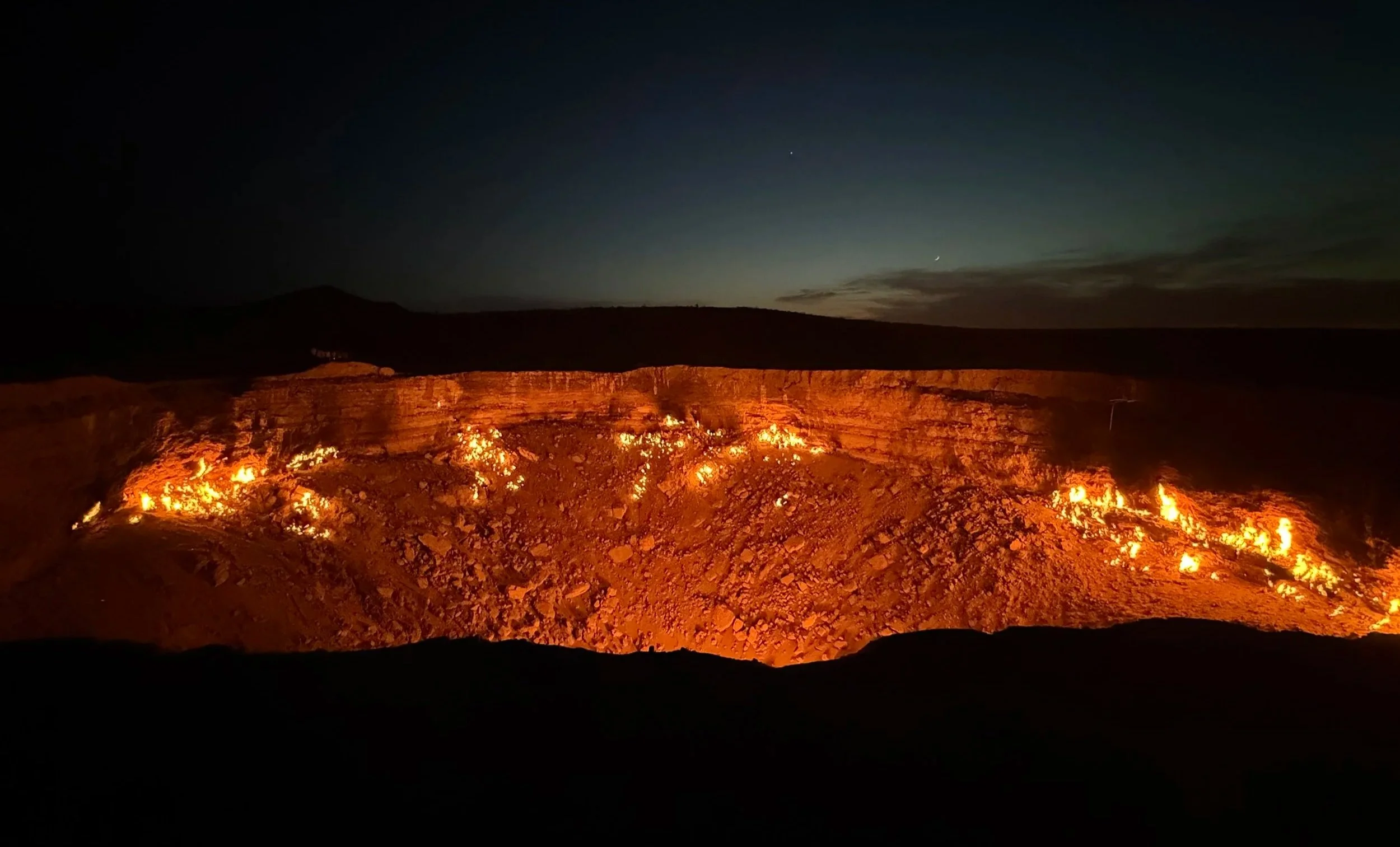
Above: The Derwaza Gas Crater at night
I woke up early to go back to the crater alone at sunrise, which turned out to be beautiful. The Karakum was silent and empty, and apart from a camel and a dog. I had the crater entirely to myself, and enjoyed the cold desert air, watched the flames lose their glow to the daylight. Amidst the Satanic inferno, I took the opportunity to listen to one of my favorite songs, Sympathy for the Devil. I’ve kept thinking about that song since, because it fits the place better than I could have planned.
Mick Jagger wrote Sympathy for the Devil after he was gifted Mikhail Bulgakov's The Master and Margarita, a novel about the devil arriving in Stalin's Moscow. The book was written under Stalin, but not published in the Soviet Union until the 1960s due to censorship laws. In Mick Jagger’s song, the devil takes credit for everything from the Russian Revolution to the Kennedy assassinations, and the joke, if there is one, is that he is not the only one who was in the room. The blame for history's worst moments turn out to be spread across everyone who took part, watched, or looked away, and the devil looks more like us than we care to admit.
Go looking for the villain at Derwaza and you do not find one. The geologists who lit the gas were trying to keep poison from drifting over nearby villages, and they expected the fire to be out within weeks. The country that inherited the problem has no official record of how it began and did not even exist at the time it was created. Turkmenistan’s president announced plans to put the fire out in January 2022, which has not happened yet. Then there are people like me, who rode over terrible roads to sit at the edge of it and call it a highlight of the trip. Nobody in that chain needed to be a villain for it to happen, and the result is still half a century of wreckless inferno.
The Journey
Select a stop to see what happened there
Stop positions and the desert outline are approximate. The route follows the main roads, simplified, and distances are by road. Road data © OpenStreetMap contributors.
Visitng the crater also serves as a fair summary of the country around it, a place where the road to its most famous natural attraction is so poor that drivers prefer the open desert, and where most of the money the gas brings in goes into marble in a capital I was about to see.
After breakfast, we met the drivers and crossed the Southern half of the Karakum on the way back to Ashgabat, on another terrible road. The desert has long been known, among locals and European explorers alike, for its harsh climate and the constant threat of Turkmen raiders, and driving through it in June I had no trouble understanding the first part of that reputation. In Ashgabat, I bought a Soviet vinyl pressing of "Stairway to Heaven" from a cab driver. It seemed like a fair answer to the crater: hell in the desert, a staircase to heaven in the marble capital, and a country that manages to contain both (and deliver both to its people).
If you go…
Independent travel in Turkmenistan is not yet possible, so you need a letter of invitation from a government approved tour agency (which also arranges your driver, so confirm current visa and transit rules with your agency before booking)
The Shavat crossing from Uzbekistan opens at 9:00 AM, prepare for a long wait on either side and a shuttle bus across a buffer zone about a mile wide (bring cash for the shuttle)
Internet inside the country is heavily censored and hard (or near impossible) to access via sim or eSim with limited time
Download offline maps and set up a VPN before you cross
Stay at hotels with WiFi to access the internet
The roads to the crater are rough enough that drivers leave them for the desert, so plan for a slow day and a bumpy ride
June daytime temperatures were close to 100 Farenheit, so bring water and sun protection.
